Research
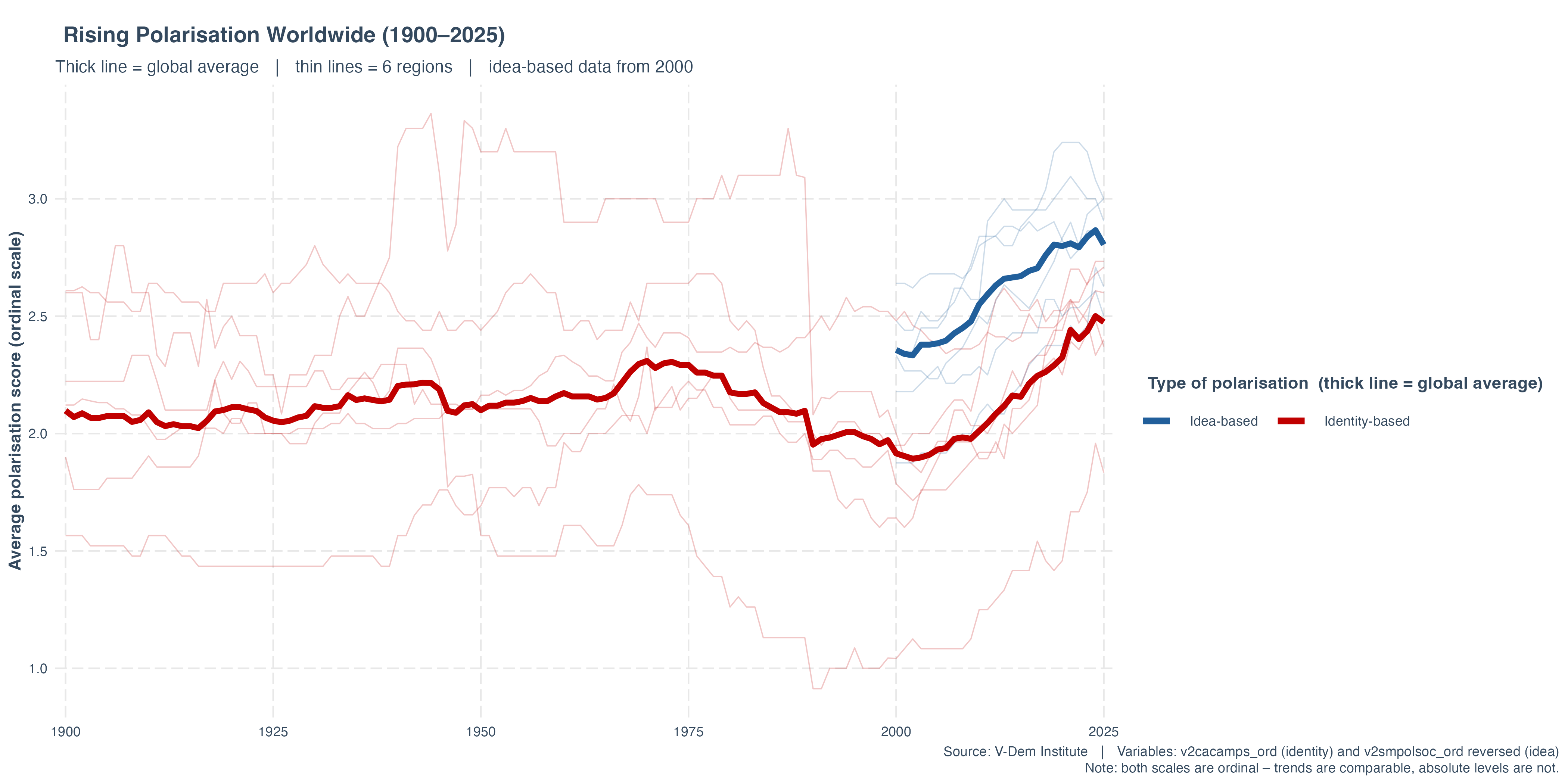
My research is driven by a simple, yet challenging question: when does conflict become a threat to democracy? Our societies are (re)polarising (see below), and the most common reaction is to see that as inherently dangerous. My work, instead, is built on the conviction that understanding this distinction — between the conflict that democracies need and the conflict that destroys them — is one of the most urgent tasks for political science today. In doing so, I have developed a strong interest in studying different sorts of polarisation, and the broader socio-institutional framework within which it erupts.
Research themes
Kinds of polarisation and democracy
How do different kinds of polarisation relate to democratic behavior?
Institutions and polarisation
How do democratic institutions shape polarisation dynamics and their consequences?
Published & accepted articles and books
Hate, not dislike? Understanding anti-democratic attitudes through a multi-dimensional understanding of affective polarization
Affect or emotions? Disaggregating affective polarisation to explain support for liberal democracy in Belgium and the United Kingdom
Summary: Friends or foes, does polarisation really undermine democracy? Understanding the two-way relationship between polarisation dynamics and the processes and institutions of democratic contestation
[Dataset] State of the Unions: survey experiment on various forms of polarisation and democratic consequences in Belgium and the UK
Friends or foes: does polarisation really undermine democracy? Understanding the two-way relationship between polarisation dynamics and the processes and institutions of democratic contestation
Fight or unite? Exploring the link between consensus institutions, polarization and political violence in 113 democracies over time (1900–2023)
Institutional design and polarization. Do consensus democracies fare better in fighting polarization than majoritarian democracies?
Deliberation and polarization: a multi-disciplinary review
Under review & working papers
Hate, not dislike? Understanding anti-democratic attitudes through a multi-dimensional understanding of affective polarisation
Polarising alone? The relationship between social contact and affective polarisation in Belgium and the UK
Beyond the culture wars? Assessing the socio-economic determinants of affective polarization