The democratic erosion unfolding before our eyes in the United States under President Trump is dramatic in both style and scope — but it is not a unique case. Political scientists have by now firmly established that democracy is in retreat worldwide. We are, in short, in the midst of a third wave of autocratisation. To measure just how widespread and steep this wave is, most researchers rely on the widely trusted V-Dem dataset. V-Dem is a research centre affiliated with the University of Gothenburg in Sweden, which collects macro-level data through expert surveys covering an extensive battery of democracy-related indicators. On 17 March, they published their annual report on the state of worldwide democracy alongside the 2025 update of their publicly available dataset. The findings are, without exaggeration, dramatic. The third wave of autocratisation shows no sign of slowing down — quite the contrary. The global state of democracy has fallen back to 1978 levels, an unprecedented number of countries are autocratising, and the wave has now reached every region of the world. Democracy is facing existential threats on a global scale.
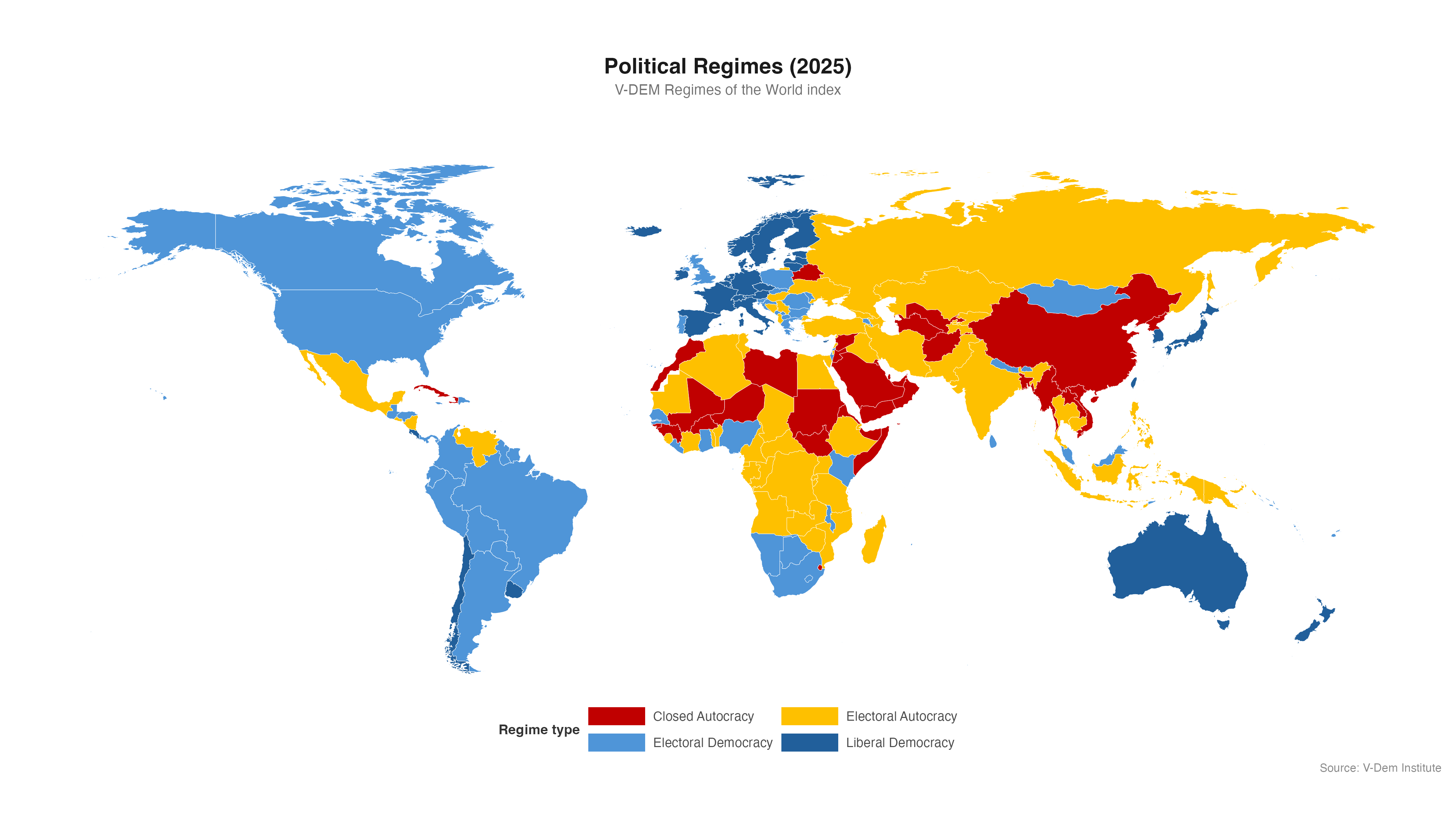
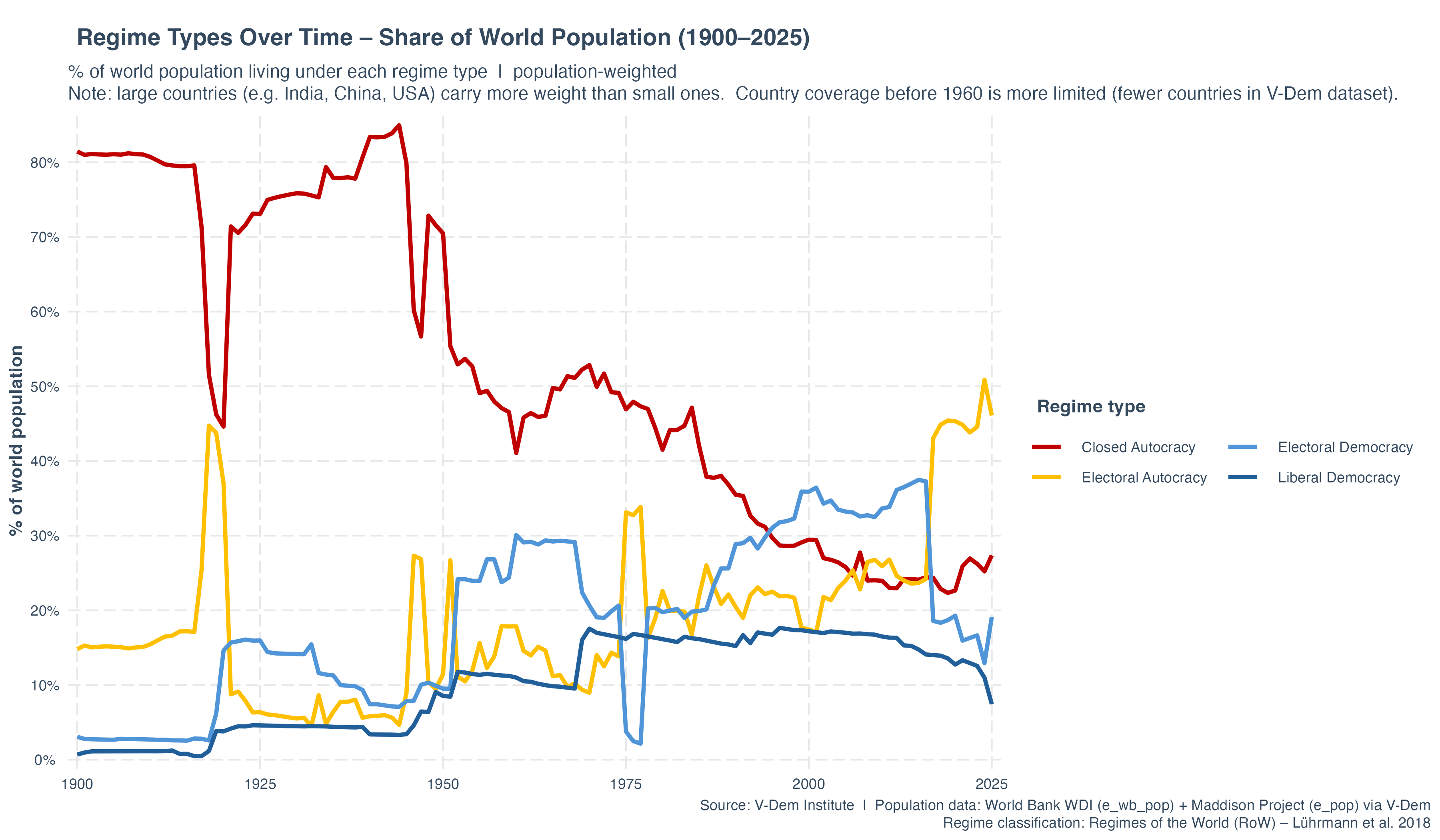
Based on V-Dem’s regime classification, the world in 2025 is mapped in Figure 1. Dark red and orange countries are respectively closed and electoral autocracies — regime types that lack free and fair elections (though electoral autocracies do permit multiparty contests) and fail to protect fundamental democratic rights. Light-blue and dark blue countries are electoral and liberal democracies, both of which hold free and fair elections; liberal democracies additionally provide strong protection of fundamental rights and liberties (more on this index here). The distribution across these categories is already telling: only 7% of the world’s citizens live in liberal democracies, while 28% live in closed autocracies. More strikingly, more people now live in closed autocracies than in all democracies combined (26%). For the second year running, liberal democracy is the least common regime type in the world. Taken broadly, almost three in four citizens — 74% — live under autocratic rule.
Figure 1
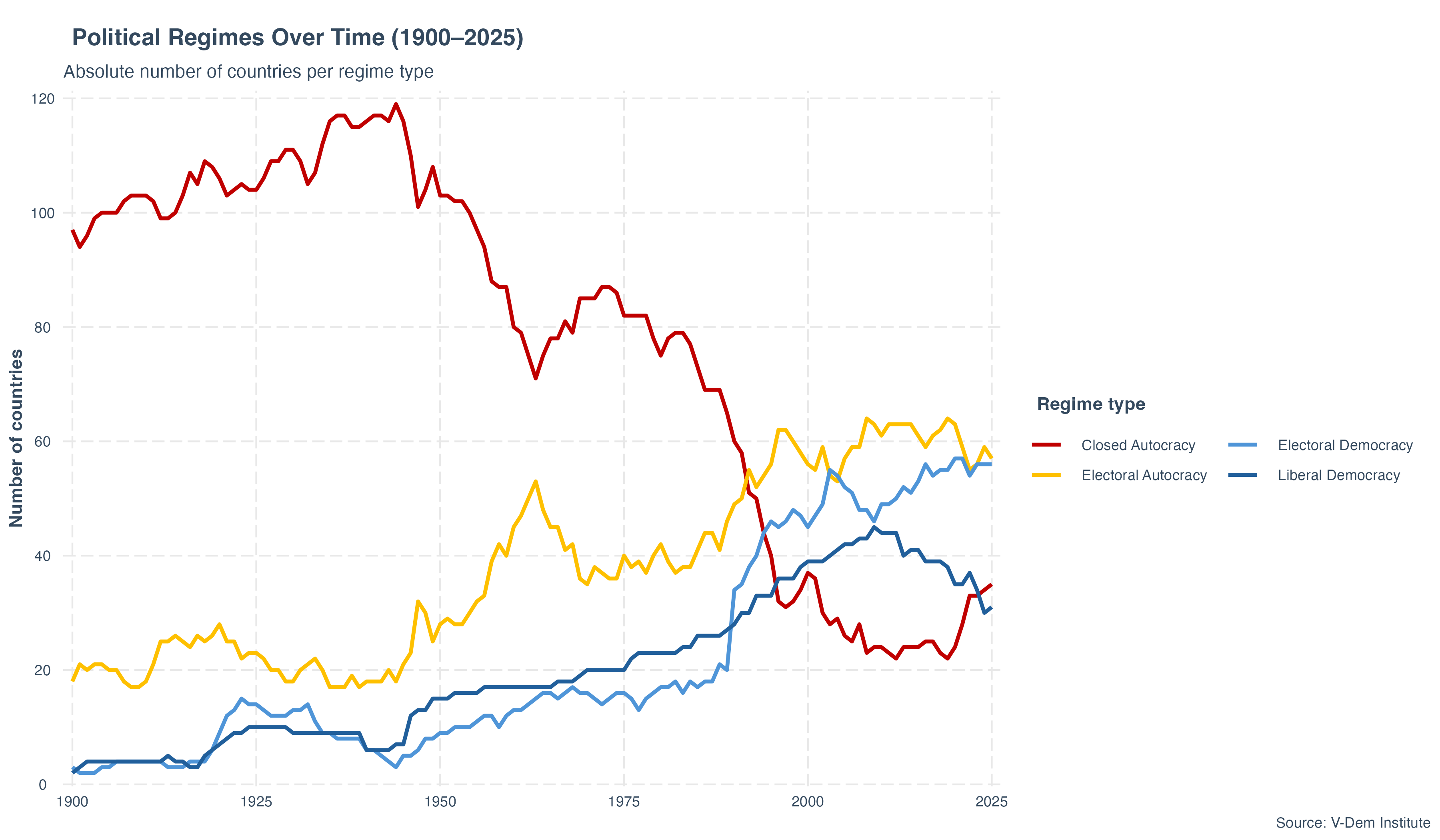
This represents a sharp downward trend from the peak of the most recent democratisation wave (see Figures 2 and 3). Around 2005, approximately 17% of the world’s citizens lived in a liberal democracy — a share that has since more than halved to just 7%, driven in large part by democratic deterioration in the United States. The decline in the number of liberal democratic countries is equally stark: from a peak of 45 in 2010, only 31 remained in 2025. Because we are coming from a historically exceptional period of democratic achievement, much of this slide does not take countries all the way to closed autocracy. A number of backsliding states are landing in the electoral democracy category. Therefore, the growing of this category should not be mistaken as good news. Yet the autocratising trend is not confined to democracies: in countries that were already autocratic, further entrenchment is also clearly visible.
Figure 2
The third wave of autocratisation shows no sign of slowing down — quite the contrary. The global state of democracy has fallen back to 1978 levels, an unprecedented number of countries are autocratising, and the wave has now reached every region of the world. Democracy is facing existential threats on a global scale.
Figure 3
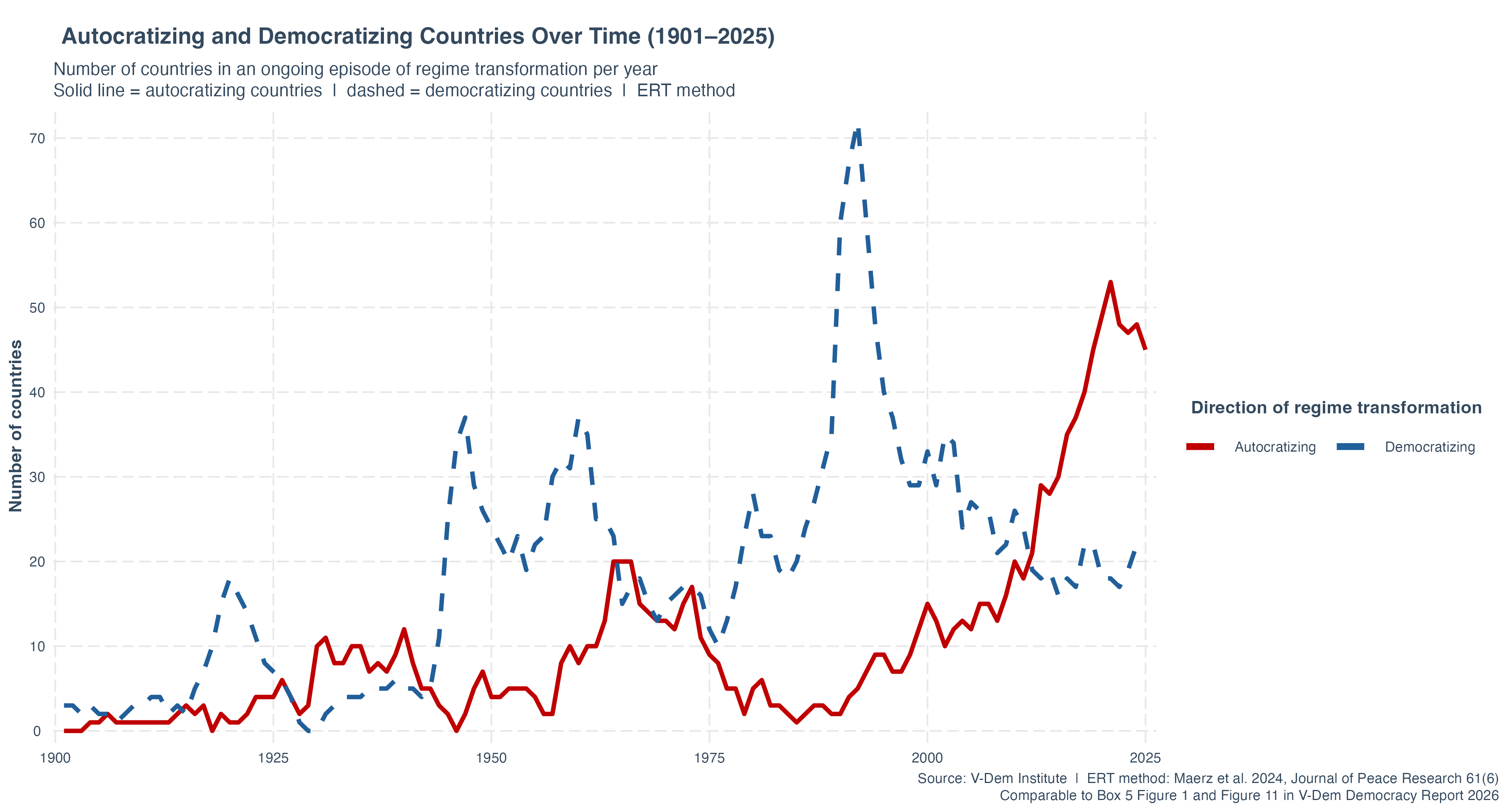
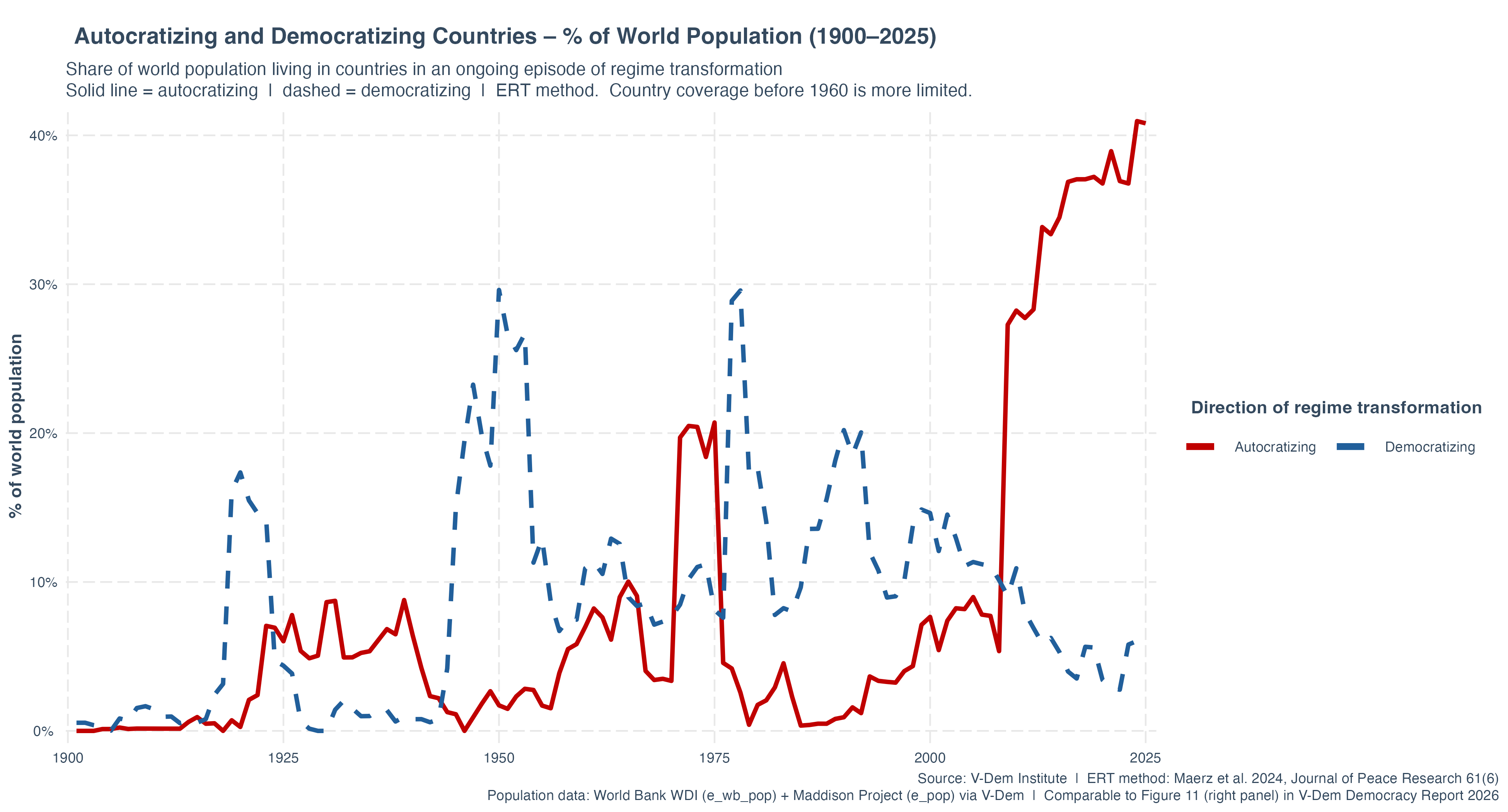
Looking further back in history, it is reassuring that we remain far from the high-water mark of autocracy in the pre-1950s. But V-Dem’s assessment is sobering nonetheless: nearly all the gains of the third wave of democratisation — which began with Portugal’s Carnation Revolution in 1974 — have now been erased. The pace and intensity of autocratisation are also accelerating. By 2025, no fewer than 41% of the world’s population lived in autocratising countries (see Figures 4 and 5). Perhaps most striking of all, whereas autocratisation had until recently been rare in the West, it is now Western Europe and North America that are registering the steepest population-weighted decline in average democracy levels.
Figure 4
More people now live in closed autocracies (28%) than in all democracies combined (26%).
Figure 5
Methodology
To empirically measure and construct these indicators, V-Dem relies on a specific methodology. As the variables of interest — quality of liberal democracy, electoral integrity, freedom of the press, and so on — are scientific concepts rather than directly observable phenomena, they cannot be measured in a straightforward way. V-Dem therefore draws on over 4,500 country experts who provide their assessments across these dimensions. Using a sophisticated technique to minimise individual biases, these ratings are then aggregated into scalable, country-year data (e.g. Belgium in 2025).
What aspects of democracy are under attack?
Beyond broad regime classifications, V-Dem’s data allow us to identify precisely which components of democracy are deteriorating — and the pattern is strikingly consistent across autocratising countries. Freedom of expression, and media freedom in particular, is the most universally targeted dimension. Government censorship of the media is deteriorating in 32 of the 44 current autocratising countries (73%), making it by far the most common instrument in the autocratiser’s toolkit. The scale of the reversal since 2000 is staggering: 25 years ago, 52 countries were improving on freedom of expression while only five were declining; today, that ratio has inverted entirely, with 44 declining and only eleven improving. Freedom of academic and cultural expression, media self-censorship, and the harassment of journalists are all deteriorating broadly.
Civil society repression has meanwhile surged dramatically, becoming the second most common autocratising tactic. This is deeply worrying, given the central role of a vibrant civil society in healthy democracies. It now affects 30 of the 44 autocratising countries (68%), up from 22 (49%) just one year earlier — a rise of 19 percentage points in a single year. Organisations working on human rights, environmental protection, minority rights, or political opposition are facing state-imposed restrictions in over two thirds of all autocratising countries simultaneously. The third major area of concern is the erosion of checks and balances — the institutions that constrain executive power. Legislative oversight, judicial independence, and compliance with court rulings are all declining across a large and growing number of countries. In the United States, legislative constraints on the executive dropped by no less than one third in a single year, the largest such drop in American history since 1789, reaching its lowest level in over a century. The message emerging from V-Dem’s data is therefore unambiguous: autocratisers systematically silence the press, strangle civil society, and concentrate executive power. Free elections, for now, remain largely intact.
Washington is leading, but in the wrong direction
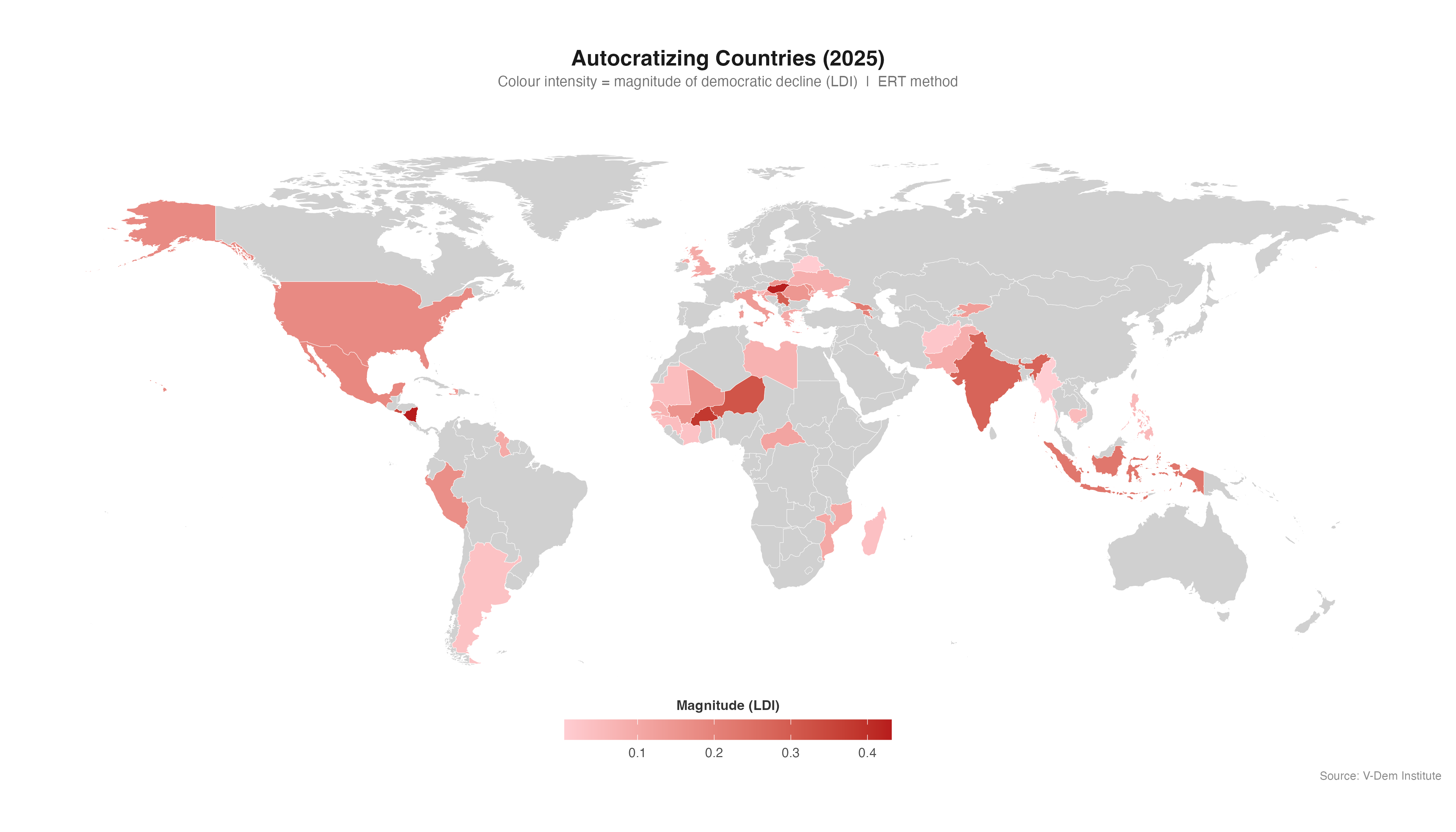
Autocratisation now affects every region of the world, though its character and intensity vary. Western Europe and North America — historically the heartland of global democracy — now register the most notable population-weighted decline in average democracy levels, driven primarily by developments in the United States. Under President Trump’s second term, the US stands out as the most dramatic and globally consequential case; V-Dem devoted an entire section of their annual report to it. The United States is not only one of the world’s most powerful and influential nations, but it also carries enormous symbolic weight as one of the oldest and most revered democracies in modern history.
In a single year, the US fell from 20th to 51st place in V-Dem’s global democracy ranking, with its Liberal Democracy Index score dropping from 0.79 to 0.57 — the largest single-year decline in American history going back to 1789. The current level of democracy in the US now equals that of 1965, the year of the Voting Rights Act and the symbolic starting point of a fully functioning American democracy. The driving force is what V-Dem calls “the most rapid executive aggrandizement in modern history”: a systematic concentration of power in the presidency at the expense of Congress, the judiciary, the press, civil society, and academia. Legislative constraints on the executive fell by one third in a single year, while freedom of expression, civil rights, and judicial independence all deteriorated sharply. To put this in context: it took Hungary’s Viktor Orbán four years to achieve a comparable drop; Serbia’s Aleksandar Vučić eight years; India’s Narendra Modi and Turkey’s Recep Tayyip Erdoğan approximately a decade each. Trump managed it in one.
The US is not alone among established democracies. The United Kingdom was newly identified as an autocratiser beginning in 2020, driven largely by sharp declines in freedom of expression and media freedom. Italy joined the list in 2021. Croatia, Slovakia, and Slovenia were all classified as new autocratisers in 2025. Hungary has been deepening its autocratic trajectory since 2009 and is now a firmly consolidated electoral autocracy. India — until recently the world’s most populous democracy — has been undergoing slow but systematic democratic erosion since 2008, driven by attacks on press freedom, civil society, and institutional independence. The lesson is uncomfortable but clear: liberal democracies once thought immune to the autocratising wave have proven just as vulnerable.
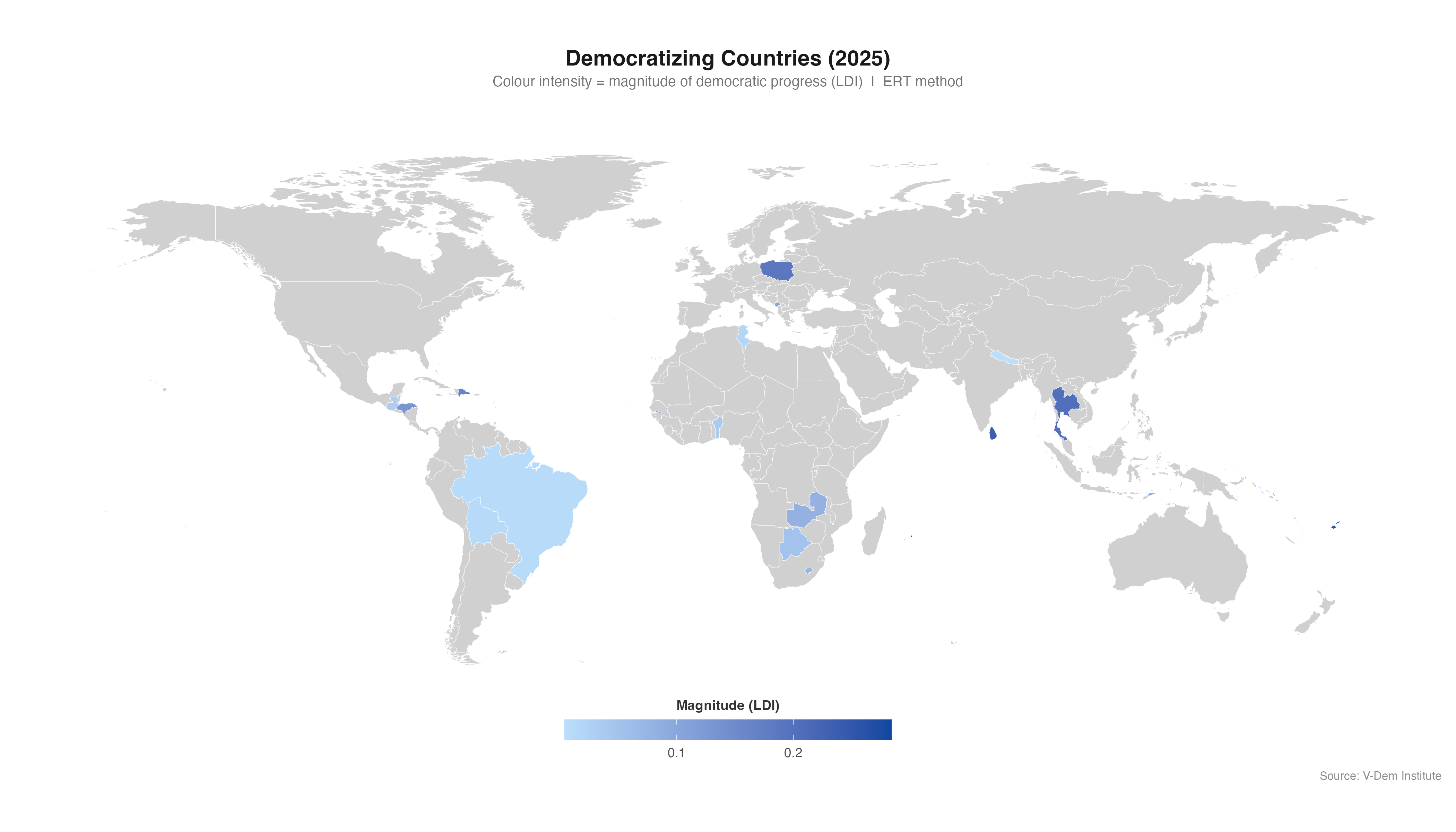
Against this backdrop, a small number of democratising cases offer cautious grounds for hope. The most notable European example is Poland’s U-turn following the 2023 elections, which brought Donald Tusk’s broad coalition to power after years of erosion under the Law and Justice party. Poland has so far managed to reverse autocratisation without a democratic breakdown, though it remains below its 2015 democracy levels. Brazil similarly halted and reversed its autocratising trajectory under Lula, aided in part by Bolsonaro’s criminal conviction and subsequent bar from office — an important vindication of the trias politica and the resilience of democratic institutions. In sub-Saharan Africa, both Botswana and Mauritius achieved meaningful democratic progress through peaceful electoral transfers of power in 2024. These “U-turn” cases demonstrate that democratic backsliding is not irreversible, and that elections remain pivotal opportunities for course correction. At the same time, no single stand-alone case of democratisation was observed in 2025 — as opposed to countries merely rebounding from a prior period of autocratisation — suggesting that the global appeal of democracy as a model has faded.
Figure 6
In a single year, the US fell from 20th to 51st place in V-Dem’s global democracy ranking, with its Liberal Democracy Index score dropping from 0.79 to 0.57 — the largest single-year decline in American history going back to 1789.
Figure 7
A wake-up call
For those of us fortunate enough to live in stable liberal democracies like Belgium, it may be tempting to treat these trends as distant concerns. That would be a serious mistake — and not merely out of solidarity with citizens elsewhere. The current wave of autocratisation is unprecedented not only in its scale and intensity, but in who is driving it. For the first time, the major engines of democratic decline include some of the world’s most economically and geopolitically powerful nations. Four of the five most populous countries on earth are now autocracies (China, India, Indonesia, and Pakistan), and the United States — by far the world’s largest economy and the historical anchor of the post-war liberal order — is deteriorating rapidly on virtually every democratic dimension. Measured by GDP-weighted averages, the global level of democracy is now at its lowest in over 50 years, down more than 36% from its peak in 2000.
For the first time, the major engines of democratic decline include some of the world’s most economically and geopolitically powerful nations.
This matters because the institutions that govern our global order are now increasingly shaped by autocratic or rapidly autocratising states. International norms around human rights, press freedom, the rule of law, and democratic legitimacy are under sustained and coordinated pressure — from within the very bodies designed to uphold them. Trade deals, foreign policy alignments, aid conditionality, and multilateral agreements on climate or security are all being reshaped by states whose domestic political logic is growing ever more autocratic. For citizens of liberal democracies, understanding this context is not optional: it is essential for making sense of the international events, diplomatic tensions, and policy shifts that increasingly define our present.
Even more important, the autocratising tsunami has made landfall in the West. The United States, the United Kingdom, and Italy — long-standing members if not founders of the Western democratic tradition — are now classified as countries in active autocratisation episodes. Liberal institutions everywhere are under pressure. Above all, this report is therefore a reminder that democracy is fragile and should never be taken for granted. It should serve as a wake-up call to defend democracy abroad and at home.